
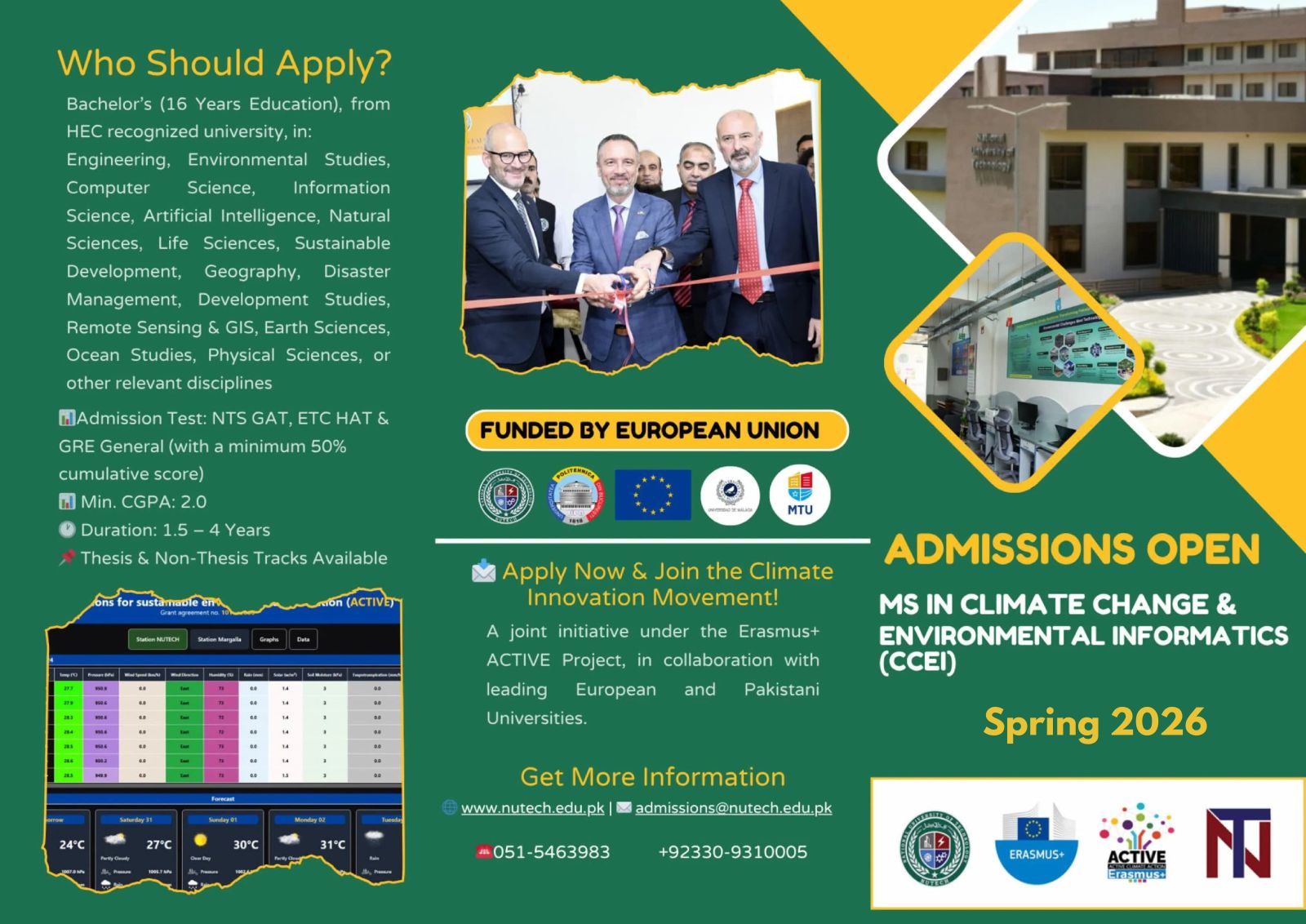

The proposed post-graduate program aims to:
The master’s degree program aims to provide students with the deeper understanding of the global shift in Information and Communication Technologies (ICT). By providing the basic knowledge of ICT and environmental studies, this program empowers students to actively contribute to this transformative change. The developed curriculum includes different case studies from around the world, considering different conditions in developed, newly industrialized, and developing country contexts. With a major focus on skills development, the developed curriculum incorporates the utilization of ICT to tackle the environmental issues. The accreditation process assures the relevance and quality of the curriculum across all partner universities in Pakistan. The Master’s program, offered by these institutions, anticipates an annual intake of approximately 30 students, stimulating a cohort of professionals prepared to contribute and navigate to the evolving landscape of ICT and climate change.
The rationale of developing this master’s program taken from the recognition of the known impact that Information and Communication Technology (ICT) can have on addressing the global challenges cause by climate change. The program’s rationale is grounded in the belief that by integrating these two fields, we can empower students to become catalysts for positive environmental change. The increasing urgency to address climate change issues requires comprehensive methods that go beyond conventional disciplinary boundaries. This requires the interdisciplinary nature of the curriculum for productive solutions to climate challenges that need collaboration across different domains such as environmental studies, engineering, policymaking, economics, and social sciences. This master’s program focus on providing a strong understanding in both ICT and climate change principles and aligns with the need for professionals who possess a detailed understanding of the technological, environmental, social, and economic aspects of these fields.
Moreover, the practical content of the curriculum motivating students to analyze, design, and implement ICT practices for environmental issues, shows the need for actionable knowledge. The integration of hands-on projects assures that graduated students are not only theoretically proficient but also equipped with practical skills to tackle real-world environmental issues. Additionally, the ethical dimension embedded in the curriculum acknowledges the responsibility that comes with technological advancements.
By focusing on the social, environmental, and economic impacts of ICT, the program aims to produce a group of professionals who aims sustainability, social equity, and environmental conservation in their technological endeavors. Another important aspect of this program is enhancing leadership and communication skills. These skills motivate graduates to communicate with stakeholders, promote for sustainable practices, and contribute meaningfully to decisionmaking processes. Lastly, the inclusion of research and innovation within the program leads to contribute to the ongoing advancement of knowledge in the field of ICT and climate change. This program stimulates a culture of continuous improvement and innovation by allowing students to explore specific areas of interest and develop creative solutions to tackle the everevolving challenges caused by climate change.
|
Sr. no. |
Course name |
Department |
Course code |
Cr. Hrs. |
|
1. |
Research Methodology |
|
RM-601 |
Qualifying scores |
|
2. |
ICT in Environmental Management |
|
IEM-602 |
3-0 |
|
3. |
Information and Communication Technologies |
|
ICT-603 |
3-0 |
|
4. |
Environmental Chemistry and Climate Impact |
|
ECC-604 |
3-0 |
|
5. |
Mathematical Models in Environmental Studies |
|
MME-605 |
3-0 |
|
6. |
Recent Trends in Environmental Engineering |
|
RES-606 |
3-0 |
|
7. |
Climate Change Adaptation and Disaster Mitigation |
|
CAD-607 |
3-0 |
|
8. |
Environmental Data Analytics and Visualization |
|
EDA-608 |
3-0 |
|
9. |
Digital Sustainability Strategies and Green IT |
|
DSG-609 |
3-0 |
|
Sr. no. |
Course name |
Department |
Course code |
Cr. Hrs. |
|
10. |
Remote Sensing and GIS |
|
RSG-610 |
3-0 |
|
11. |
Renewable Energy Technologies |
|
RET-611 |
3-0 |
|
12. |
Advanced Energy Modeling and Simulation |
|
AEM-612 |
3-0 |
|
13. |
Environmental Governance and CTs |
|
EGI-613 |
3-0 |
|
14. |
Sustainable Agriculture |
|
SAT-614 |
3-0 |
|
15. |
Air Pollution Control and Management |
|
APC-615 |
3-0 |
|
16. |
Environmental Meteorology and Pollution Modeling |
|
EMM-616 |
3-0 |
|
17. |
Smart Solid Waste Management |
|
SWM-617 |
3-0 |
|
18. |
Hydro informatics and Environmental Modeling |
|
HEM-618 |
3-0 |
|
19. |
ICT-Enabled Natural Resource Management |
|
ICN-618 |
3-0 |
|
20. |
Statistical Methods for Environmental Resilience |
|
SME-620 |
3-0 |
|
21. |
ICT-Enabled Disaster Risk Reduction and Management |
|
IDM-621 |
3-0 |
|
22. |
Introduction to Machine Learning |
|
ML-622 |
3-0 |
|
23. |
Environmental Data Science and Technology Applications |
|
EDT-623 |
3-0 |
|
24. |
Systems Thinking and Sustainability |
|
STS-624 |
3-0 |
|
25. |
ICT in Marine Environmental Management |
|
IMM-625 |
3-0 |
|
26. |
Computer Vision Techniques in Environment Monitoring |
|
CTE-626 |
3-0 |
|
27. |
Industrial wastewater pollution control |
|
IWP-627 |
3-0 |
|
28. |
Virtual Reality for Environmental Education and Advocacy |
|
VER-628 |
3-0 |
|
29. |
IoT based techniques in Environmental Monitoring |
|
IEM-629 |
3-0 |
|
30. |
Eco-friendly Design and Sustainable Development |
|
EDD-630 |
3-0 |
|
31. |
Glacial Lake Outburst Floods (GLOFs): Risk Assessment and Mitigation |
|
GRA-631 |
3-0 |
|
32. |
ICT and Wildlife Conservation |
|
IWC-632 |
3-0 |
|
33. |
Industrial Air Pollution Monitoring |
|
IAM-633 |
3-0 |
Major applied as well as theoretical research areas include but are not limited to:
The inclusion of proposed program will benefit community in various ways including:


