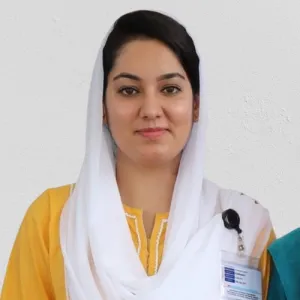
I am Ayesha Khalid, Lecturer in the Department of Computer Science at National University of Technology (NUTECH), Islamabad. I have several years of experience in academia, having taught at different institutions. My primary research interests lie in Computer Vision and Deep Learning. I am passionate about applying computing techniques to solve real-world problems, particularly in intelligent systems and image analysis. My teaching philosophy focuses on bridging the gap between academia and industry by emphasizing conceptual clarity, practical application, and critical thinking, enabling students to adapt effectively to evolving technological demands.
Lecturer, Computer Science, National University of Technology (NUTECH), Islamabad (2025–Present)
Teach undergraduate students, mentor academic development, supervise ICAT projects, contribute to departmental Board of Studies (DBS) meetings, and coordinate OBE activities.
Lecturer, Computer Science, Ibadat International University, Islamabad (2024–2025)
Served as Batch Advisor and FYP Coordinator; mentored students and supported academic and project activities.
Lecturer, Computer Science, Shifa Tameer-e-Millat University, Islamabad (2023–2024)
Delivered undergraduate teaching, provided academic advising, and contributed to curriculum-related activities.
Lecturer, Computer Science, Iqra University, Islamabad (2022–2023)
Engaged in undergraduate teaching, quality assurance processes, curriculum development, and FYP coordination.
Teaching Assistant, UET Taxila (2018–2020)
Assisted in teaching, conducted labs, and supported student assessments and projects.
MS in Computer Science (Computer Vision & Deep Learning), University of Engineering and Technology (UET) Taxila, Pakistan (2023)
BS in Computer Science, International Islamic University, Islamabad, Pakistan (2018)
I have published multiple research papers in recognized journals in the areas of Computer Vision, Deep Learning, and Internet of Things (IoT), focusing on real-world problem-solving applications.
I have taught a variety of undergraduate-level courses in Computer Science. Below are the courses I have been involved in teaching:
- Data Structures and Algorithms
- Design and Analysis of Algorithms
- Object-Oriented Programming
- Programming Fundamentals
- Database Management Systems
- Digital Logic Design
- Introduction to Computing
- Digital Image Processing
- Compiler Construction
- Web Technologies
My research focuses on Computer Vision and Deep Learning, particularly in object detection and recognition in challenging environments. My MS research explored vehicle detection using advanced deep learning models, contributing to intelligent transportation systems and real-time monitoring applications.
I have also worked on image processing and pattern recognition, including baggage detection and IoT-based accident monitoring systems. My research emphasizes practical, data-driven solutions for real-world problems.
I am particularly interested in integrating Artificial Intelligence with Computer Vision and IoT to develop intelligent, efficient, and scalable systems for smart surveillance and automated decision-making.
1. Ayesha, , Iqbal, M.J., Ahmad, I., Alassafi, M.O., Alfakeeh, A.S. et al. (2023). Vehicle Detection in Challenging Scenes Using CenterNet Based Approach. Computers, Materials & Continua, 74(2), 3647–3661. https://doi.org/10.32604/cmc.2023.020916
2.Ayesha, Ali Khan, Muhammad Nadeem, Syeda Wajiha Zahra, Ali Arshad, Saman Riaz, Usman Shahid. Baggage Detection and Recognition Using Local Tri-Directional Pattern. International Journal of Mobile Computing Technology. 2023; 01(01):8-17. Available from: https://journals.stmjournals.com/ijmct/article=2023/view=112949
3.Khan, J. A., Ahmad, W., Hussain, A., Zahra , S. W., Nadeem, M., & Ayesha. (2023). Witness System of Vehicle Accidents Based on the Internet of Things. Research Reports on Computer Science, 2(2), 111–127. https://doi.org/10.37256/rrcs.2220233275
Additionally, I have served as a research paper reviewer for the 4th International Conference on Engineering & Computing Technologies (ICECT 2025), contributing to the peer-review and evaluation of scholarly submissions.