
logo

European Union Centre of Excellence

scroll down

About EU CoE

The European Union Centre of Excellence (EU CoE) for Climate Action with ICT at National University of Technology (NUTECH) is a strategic interdisciplinary platform established under the European Union funded Erasmus+ CBHE project “ICT Applications for Sustainable Environmental Protection (ACTIVE)” (Grant Agreement No. 101082866). Developed in collaboration with leading European academic institutions across Ireland, Spain, and Romania, the Centre reflects international academic standards, EU-aligned quality frameworks, and globally recognized research practices.

The EU CoE integrates advanced Information and Communication Technologies including Artificial Intelligence (AI), Internet of Things (IoT), remote sensing and geospatial systems to develop real time data driven solutions for addressing complex environmental and sustainability challenges.
While its foundation is anchored in the ACTIVE project, the EU CoE has evolved into a dynamic national hub of excellence with a broad mandate, operating at the intersection of climate science, digital technologies, consultancy, innovation, and policy development.

The EU CoE serves as a high impact research platform for securing, and managing national and international research funding, with a strong track record in European Union grants, including international Credit mobility grants, and national funding. The EU CoE also provides specialized interdisciplinary consultancy & services in sustainability, environmental monitoring, funding acquisition, and technology-driven decision support systems, supported by state of the art equipment. A key pillar of the EU CoE is capacity building through faculty training, technical workshops, and professional development in AI applications, environmental data management, and emerging technologies, along with support for research Centre development and policy implementation.

EU CoE is recognized as a national hub of excellence for its technical expertise in:

  • High Impact Complex Environmental solutions with IcT
  • National & International Research Funding Grants
  • Consultancy & Services
  • Capacity Building & Institutional Training
  • International Collaboration & Consortium formation

EU CoE operates as a comprehensive ecosystem that not only addresses climate and environmental challenges but also drives broader transformation in higher education, industry, and society. It stands as a national model for integrating technology, sustainabilisty, and innovation into a cohesive and impact driven framework.

Vision

To be a globally recognized Centre of excellence leading transformative innovation and multidisciplinary knowledge creation through cutting edge digital technologies, shaping resilient and sustainable institutions for the future.

Mission

To deliver impactful research, innovation, and capacity building through ICT enabled solutions, while strengthening institutional systems, fostering global partnerships, and enabling sustainable socio economic development across diverse sectors.

Director

Engr. Prof. Dr. Marium J. Chaudhry (T.I)

It is a matter of great pride to lead the EU Centre of Excellence at the National University of Technology (NUTECH), an initiative that reflects strong international collaboration and a shared commitment to addressing contemporary global challenges through knowledge, innovation, and applied research. Over time, The EU CoE has evolved into a multidisciplinary platform that integrates research, consultancy, and capacity building to address complex national and global challenges. Through sustained engagement with leading international partners, particularly in Europe, it has strengthened academic cooperation, facilitated joint research activities, and expanded opportunities for institutional collaboration.

One of the key strengths of the EU CoE lies in its ability to translate global partnerships into tangible national outcomes. This is reflected in the development of new academic directions, enhancement of research capacity, and successful participation in competitive funding and mobility programs at both national and international levels. At the national level, the EU CoE continues to support the strengthening of higher education Institutes through research enhancement, institutional capacity building, and professional training programs. At the international level, it is actively engaged in collaborative research networks, funding programs, and knowledge exchange initiatives that reinforce its position as a credible global partner. The leadership and faculty associated with the EU CoE inking, enabling contributions that extend beyond academia into practical, real-world impact. These efforts are aligned with broader national priorities of innovation, digital transformation, and sustainable development.

Looking ahead, the EU CoE remains committed to expanding its collaborative footprint, enhancing research quality, and deepening its engagement with global partners, while continuing to contribute meaningfully to national development and international knowledge systems.

Grants Funded Projects

Ongoing Projects

International Projects

1. ICT Applications for sustainable Environmental Protection (ACTIVE)

The project ACTIVE is an CBHE Erasmus+ initiative funded by the European Union, Grant Agreement No:101082866. It is implemented by the seven partner universities: National University of Technology (NUTECH), University of Málaga (Spain), Munster Technological University (Ireland), and Polytechnic University of Bucharest (Romania). Other national HEIs include, (BUITEMS) Quetta, (MUET) Jamshoro and (SSUET) Karachi. 

Objective:

The project focuses on three key objectives:

  • Capacity building through academic development that lead to launch of Pakistan’s first multidisciplinary MS in Climate Change and Environmental Informatics at National University of Technology (NUTECH)
  • Establishment of a Centre of Excellence to strengthen research and innovation capacity
  • Development of ICT-based environmental solutions supported by state-of-the-art equipment for research and practical applications.

Media Links:


2. International Credit Mobility (ICM) Grant- ERASMUS+ KA171  Munster University of Technology (MTU), Ireland.

The Erasmus+ International Credit Mobility (KA171) project is an European Union funded initiative that supports academic exchange and cooperation between European and partner country higher education institutions. It enables structured mobility between Munster Technological University (MTU), Ireland and National University of Technology (NUTECH), Pakistan, promoting academic collaboration in higher education, research, and training.

Objective: The main objective of the program is to enhance academic and professional skills through student traineeships, research activities, and coursework mobility. It aims to strengthen innovation, knowledge exchange, and institutional cooperation between Munster Technological University (Ireland) and National University of Technology (Pakistan), while developing global competencies in students and researchers.


3. International Credit Mobility (ICM) Grant- ERASMUS+ KA171 Maynooth University, Ireland

The Erasmus+ International Credit Mobility (KA171) programme between Maynooth University, Ireland and National University of Technology (NUTECH), Pakistan is a European Union–funded initiative designed to promote academic exchange, research collaboration, and international cooperation in higher education. It provides opportunities for students and researchers to engage in advanced academic environments with a strong focus on research-driven learning and interdisciplinary development.

Objective: The programme aims to strengthen academic and research capacity through student mobility, research collaboration, and coursework exchange at Maynooth University. It focuses on enhancing analytical skills, research methodologies, and interdisciplinary understanding, while fostering academic cooperation and long-term institutional partnerships between Ireland and Pakistan.


National Projects

1. IoT-Driven Monitoring and Tracking Framework for Healthcare Waste Management in Urban Hospitals

This research project is funded by the Higher Education Commission (HEC) under the National Research Program for Universities (NRPU). The project is being implemented at the National University of Technology (NUTECH) and focuses on developing an intelligent IoT-based system for real-time monitoring and tracking of healthcare waste in urban hospital settings. It addresses the need for improved safety, transparency, and efficiency in medical waste management through digital and data-driven solutions.

Objective: The objective of this project is to design and develop an IoT-enabled framework for effective monitoring and tracking of healthcare waste to ensure safe handling, proper segregation, and timely disposal in urban hospitals. The project aims to reduce environmental and health risks, improve operational efficiency, and enable data-driven decision-making for sustainable and compliant healthcare waste management systems.


2. National Center for Manufacturing Execution System and Industrial Automation

The National Center for Manufacturing Execution System and Industrial Automation is funded by the Government of Pakistan under PSDP through the Planning & Development (P&D) Division and Higher Education Commission (HEC). It aims to promote research, innovation, and industry–academia collaboration in manufacturing systems and industrial automation.

Objective: The objective of the Centre is to develop and implement advanced manufacturing and automation solutions to enhance industrial efficiency, productivity, and competitiveness. It focuses on building technical capacity, supporting applied research, facilitating technology transfer, and enabling integration of smart manufacturing systems, thereby contributing to Pakistan’s industrial modernization and economic growth.


Completed Projects

  1. Initial Training Network (ITN) Marie Curie project that is focused on the analysis, design, and optimization of energy efficient wireless communication systems and networks (GREENET) 
    Funding Agency: European Union (2011 -2015)
  2. British Council Charles Wallace Fellowship (2024) Pak-UK Mobility Gateway
    Funding Agency: British Council
  3. Innovative, Impactful and Collaborative Research; PAK UK Gateway Mobility (2019- 2020) with University of Edinburgh UK
    Funding Agency: British Council

Submitted/ Under review/ Shortlisted Projects

  1. Project Title: “Technology-driven Recycling Approaches to promote Circular Economy practices in Pakistan (TRACE-Pak)”
    Funding Agency: European Commission (SWITCH ASIA 2026)
    Consortium Partners: The University of Málaga (UMA), Spain, TH Köln, Germany, Bert Energy GmbH, Germany, Süleyman Demirel University (Turkey), Tribhuvan University (Nepal), LNEG (Portugal), Fraunhofer IBP (Germany)
    Objectives: To build climate-resilient, low-carbon value chains in Gilgit-Baltistan with climate-smart solutions, higher farmer incomes, AI-GIS tracking, and 50% women’s leadership.
  2. Project Title: “Disaster Analytics and Management Network (DAMAN): A Collaborative Intelligence Framework for Proactive Disaster Response”
    Funding Agency: Pakistan Science Foundation (2026)
    Consortium Partners: The Chinese University of Hong Kong, Shenzhen
    Objectives: To develop a scalable AI platform integrating multi-level and social data for proactive disaster detection, evidence-based response, and coordinated situational awareness via a Common Operational Picture.
  3. Project Title: “Secure Integrated Sensing and AI-Driven Data Fusion for Enhancing Operational Resilience Against Rapid Hydro-Climatic Extremes in Contested Environments (SHIELD-Whiplash)”
    Funding Agency: NATO SPS 2026
    Consortium Partners: UNESCO-IHE Institute for water education Netherlands, Munster university of  Technology, Ireland, National of Technical University of Ukraine
    Objectives: To develop an AI-driven system integrating SAR, IoT, and social sensing data to forecast hydro-climatic whiplash and deliver actionable terrain and 23–38 day insights for improved resilience.
  4. Project Title: Climate Resilience Academic Development and Learning Ecosystem (CRADLE)
    Funding Agency: Erasmus+ (CBHE-2026)
    Consortium Partners: Kristianstad University, Sweden, The Chinese University of Hong Kong (CUHK), Hong Kong, Munster Technological University (MTU), Ireland,
    Objectives: To modernize climate education with digital, interdisciplinary curricula and global collaboration while strengthening capacity and aligning with national climate and SDG priorities.
  5. Project Title: “Climate Leadership through Energy-Aware Resilience (CLEAR): Transforming Higher Education through Autonomous Digitalization (THREAD)
    Funding Agency: Erasmus+ (CBHE-2026)”
    Consortium Partners: Tribhuvan University - Central Department of Environmental Science (CDES), Nepal, National Technical University of Ukraine “Igor Sikorsky Kyiv Polytechnic Institute”, Ukraine, Chernihiv Polytechnic National University, Ukraine, University from Hong Kong
    Objectives: To modernize higher education with digital, interdisciplinary sustainable energy curricula and boost societal impact through international cooperation aligned with Green Deal priorities.
  6. Project Title: “Digital Transformation for Circular and Sustainable Energy Education (DI-TRACE)”
    Funding Agency: Erasmus+ (CBHE-2026)
    Consortium Partners: Burgas State University “Prof. Dr. Asen Zlatarov”, Burgas, Bulgaria, University of L’Aquila, Italy, Maynooth University (National University of Ireland, Maynooth) Ireland
    Objectives: To modernize higher education with digital, interdisciplinary sustainable energy curricula and strengthen societal impact through international cooperation aligned with Green Deal priorities.
  7. Project Title: “Building Capacity in AI-Enabled Digital Forensics for Digital Trust (AI-ForTrus)”
    Funding Agency: Erasmus+ (CBHE-2026)
    Consortium Partners: Eötvös Loránd University, Faculty of Informatics (ELTE/IK), Budapest, Hungary, HAW Hamburg, Hamburg University of Applied Sciences, Germany
    Objectives: To develop an AI-forensics curriculum with 5 labs, 2 MS programs, 10 electives, training for 60 staff, 500 learners, and stakeholder engagement through 12 MoUs and 8 case studies.
  8. Project Title: “Transforming national higher education governance through a quality system for outcome-based education (GOVERN-QS)”.
    Funding Agency: Erasmus+ (CBHE-2026)
    Consortium Partners: Politecnico di Milano (POLIMI), Italy, University of Málaga Spain
    Objectives: To modernize higher education governance and quality assurance with digital, ESG-aligned practices, boosting transparency, internationalization, and recognition for EU-Pakistan cooperation.
  9. Project Title: “Transforming Pakistani Universities into Health Computing Capacity Anchors for AI-Enabled Women’s Health (Pak-Health Hub)”
    Funding Agency: Erasmus+ (CBHE-2026)
    Consortium Partners: Politecnico di Milano (POLIMI), Italy, International Hellenic University (IHU), Greece
    Objectives: To develop sustainable AI-enabled digital health infrastructure, integrate AI into curricula, build capacity, and strengthen EU–Pakistan collaboration with institutional ownership.
  10. Project Title: “Digital Global Gateway for Inclusive Technologies: Enhancing HEIs Capacity for Disability Inclusion through Digital Transformation  (DiGG-IT)”
    Funding Agency: Erasmus+ (CBHE-2026)”
    Consortium Partners: University of L’Aquila, Italy, Technical University of Cluj-Napoca, Romania, Istanbul Gedik University, Türkiye, Chiang Mai University, College of Arts, Media and Technology, Thailand, Department of Community Medicine, Faculty of Medicine, Chiang Mai University, Thailand, Mae Fah Luang University, Thailand.
    Objectives: To establish Technology Centers for Disabilities creating AI/ML/VR assistive solutions while building capacity and embedding accessibility in higher education.
  11. Project Title: “STEM Transformation through Education Policies in Provinces (STEPP), of Pakistan”
    Funding Agency: Erasmus+ (CBHE-2026)
    Consortium Partners: European Centre for Studies and Initiatives (Centro Europeo di Studi e Iniziative) Third Sector Entity (Ente del Terzo Settore) Sicily, Italy.
    Objectives: To implement a provincial STEM and Digital Higher Education Reform Framework enhancing HEI quality, access, and inclusivity through faculty, digital readiness, curricula, and STEM hubs.
  12. Project Title: “Smart Hybrid Brick Kiln System for Low-Emission Brick Production in Pakistan”
    Funding Agency: Global Environment Facility (GEF) Mitigation Facility Action Call
    Consortium Partners: Deutsche Gesellschaft für Internationale Zusammenarbeit (GIZ), Ministry of Planning Development & Special Initiatives, Government of Pakistan, Ministry of Science and Technology, Government of Pakistan, Pakistan Climate Change Authority (PCCA), Government of  Pakistan, Ministry of Industries & Production (MoI&P), Government of Pakistan, Pakistan Climate Change Authority (PCCA), Government of Pakistan. AI Geo navigators, Brick kiln owner association of Pakistan
    Objectives: To cut emissions from Pakistan's brick kilns via waste-heat recovery, solar integration, and efficiency improvements, boosting climate, air quality, and public health.

Collaborations & Partnerships

EU Engagement & International Collaboration

The EU Centre of Excellence & NUTECH maintains strong engagement with national and international partners across multiple levels. These collaborations include European institutions, industry, government, and local organizations, supporting research, innovation, and knowledge exchange. The Centre also promotes capacity building, institutional development, and technology transfer. Through these partnerships, it strengthens its role in connecting academia, industry, and global research networks.

European HEIs / International Partners & Associated Projects

  • University of Málaga, Spain - ACTIVE Project; TRACE-Pak; GOVERN-QS 
  • Munster Technological University, Ireland - ACTIVE Project; KA171 Mobility (MTU); CRADLE 
  • Maynooth University, Ireland - KA171 Mobility (Maynooth); DI-TRACE 
  • Polytechnic University of Bucharest, Romania - ACTIVE Project 
  • TH Köln, Germany - TRACE-Pak 
  • Bert Energy GmbH, Germany - TRACE-Pak 
  • Fraunhofer IBP, Germany - TRACE-Pak 
  • Süleyman Demirel University, Turkey - TRACE-Pak 
  • Tribhuvan University, Nepal - TRACE-Pak; CLEAR 
  • LNEG, Portugal - TRACE-Pak 
  • Kristianstad University, Sweden -CRADLE 
  • The Chinese University of Hong Kong (CUHK), Hong Kong - CRADLE 
  • National Technical University of Ukraine - SHIELD-Whiplash 
  • UNESCO-IHE Institute for Water Education, Netherlands - SHIELD-Whiplash 
  • University of L’Aquila, Italy - DI-TRACE; DiGG-IT 
  • Burgas State University, Bulgaria - DI-TRACE 
  • Eötvös Loránd University (ELTE), Hungary - AI-ForTrus 
  • Hamburg University of Applied Sciences (HAW Hamburg), Germany - AI-ForTrus 
  • Politecnico di Milano, Italy - GOVERN-QS; Pak-Health Hub 
  • International Hellenic University, Greece - Pak-Health Hub 
  • Technical University of Cluj-Napoca, Romania - DiGG-IT 
  • Istanbul Gedik University, Türkiye - DiGG-IT 
  • Chiang Mai University, Thailand - DiGG-IT 
  • Mae Fah Luang University, Thailand - DiGG-IT 
  • University of Glasgow, UK - Charles Wallace Fellowship 
  • University of Edinburgh, UK - Pak-UK Gateway Mobility

Pakistani HEIs / Government / Organizations & Associated Projects

  • Balochistan University of Information Technology, Engineering and Management Sciences (BUITEMS), Quetta - ACTIVE 
  • Mehran University of Engineering and Technology (MUET), Jamshoro - ACTIVE 
  • Sir Syed University of Engineering and Technology (SSUET), Karachi - ACTIVE 
  • Higher Education Commission (HEC), Pakistan - NRPU Project; PSDP Center 
  • Planning & Development Division (P&D), Pakistan - PSDP Center 
  • Pakistan Science Foundation (PSF) - DAMAN 
  • Ministry of Planning, Development & Special Initiatives - Brick Kiln Project 
  • Ministry of Science and Technology, Pakistan - Brick Kiln Project 
  • Ministry of Industries & Production, Pakistan - Brick Kiln Project 
  • Pakistan Climate Change Authority (PCCA) - Brick Kiln Project

National Companies / Industry Partners & Associated Projects

  • ALFOZE - ACTIVE, NRPU IoT Healthcare Waste Project 
  • STRONGMAN Pvt. Ltd. - NRPU IoT Healthcare Waste Project 
  • AlQasim Waste & Facilitation Pvt. Ltd. - NRPU IoT Healthcare Waste Project 
  • AI Geo Navigators - Brick Kiln Project 
  • Brick Kiln Owners Association of Pakistan - Brick Kiln Project 
  • Deutsche Gesellschaft für Internationale Zusammenarbeit (GIZ) - Brick Kiln Project (International development agency with local implementation role) 

MoUs / LoUs 

The Centre has formalized strategic partnerships through Memoranda of Understanding (MoUs) and Letters of Understanding (LoUs) with leading organizations to promote joint research, data sharing, policy engagement, and capacity development. Key partner institutions include:

  • Pakistan Meteorological Department (PMD) - collaboration in weather data, forecasting, and climate monitoring 
  • Islamabad Wildlife Management Board - biodiversity conservation and environmental protection initiatives
  • National Agricultural Research Centre - climate-smart agriculture and environmental research 

These collaborations enable the Centre to bridge academia, policy, and practice, ensuring real-world impact and national relevance.

Products, Prototypes & Consultancy

ICT & Digital Innovation Systems

Products

1. Automatic Weather Stations (AWS)
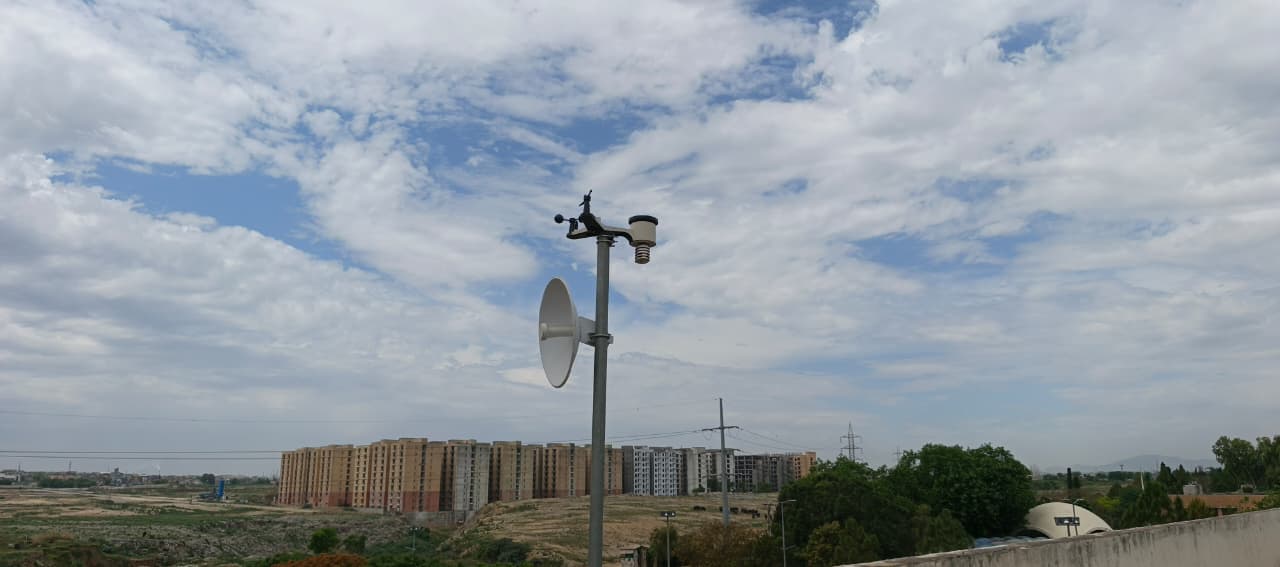
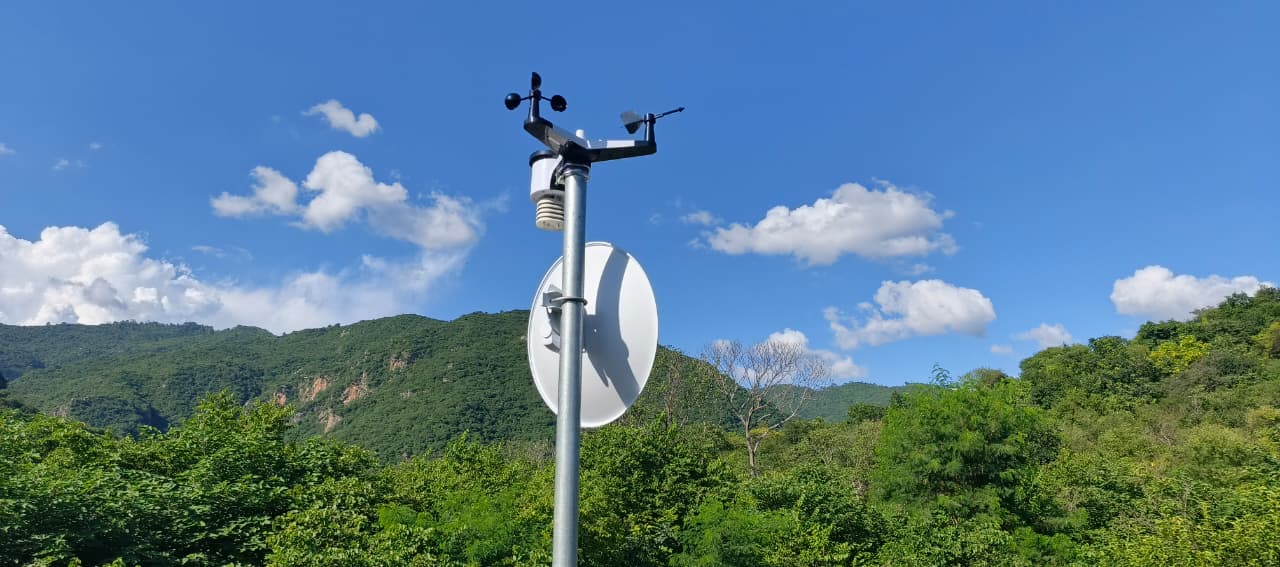
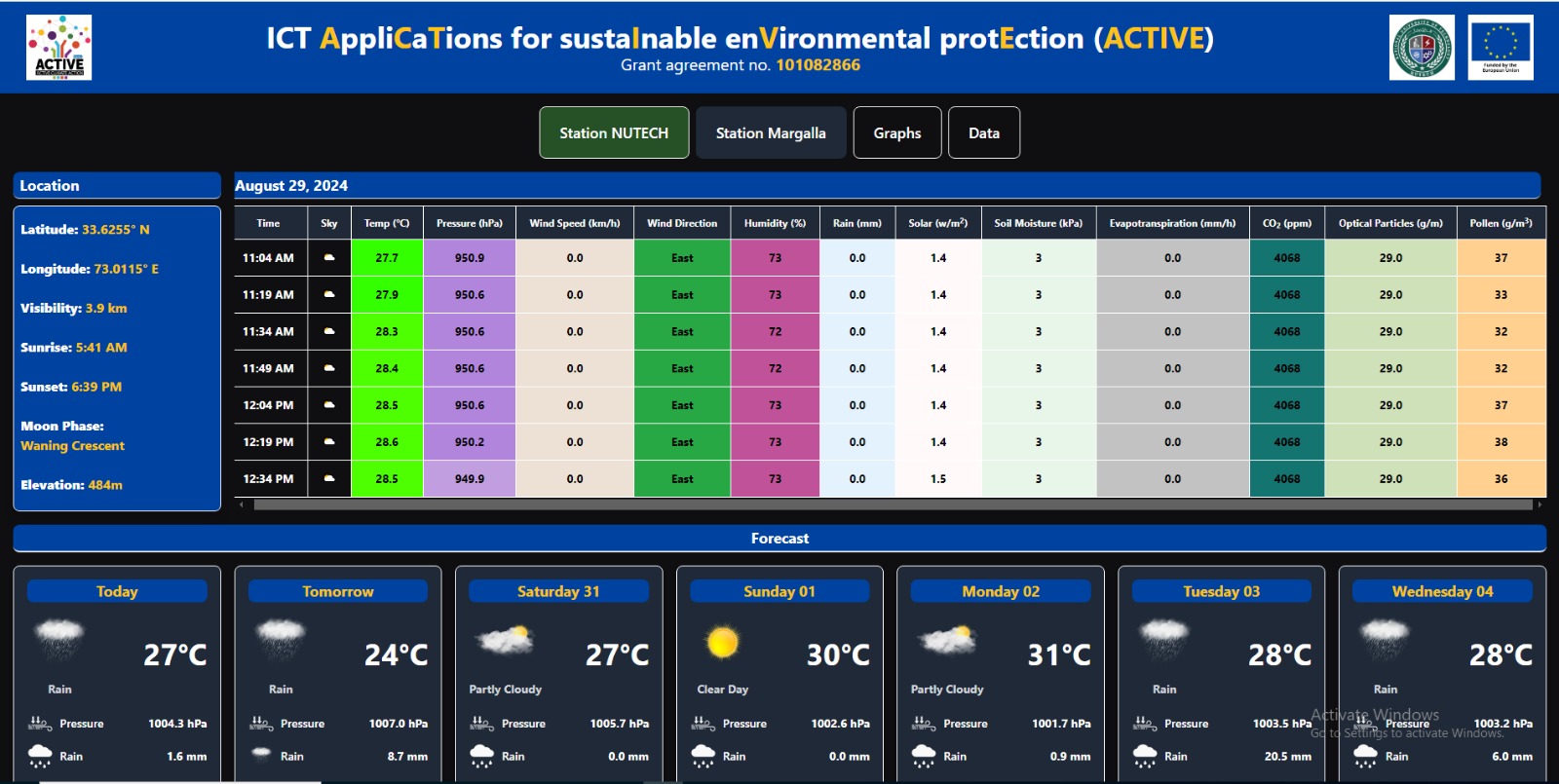
The EU CoE has deployed two state-of-the-art Automatic Weather Stations at NUTECH and Margalla Hills, equipped with soil moisture sensors and integrated real-time data transmission systems. The stations provide continuous, location-specific environmental data through a customized digital dashboard developed by the Centre.

Services:

  • Real-time weather and soil data for research and decision-making 
  • Supports climate monitoring, agriculture planning, and environmental analysis 
  • Enables comparative analysis across different ecological zones of Islamabad 
  • Facilitates data-driven research, forecasting, and policy support 
  • Provides a scalable model for smart environmental monitoring systems 

Weather Station at NUTECH

Weather Station at Margalla Hills

Weather Station LIve Dashboard

2. Trail Cameras (Biodiversity Monitoring Systems)

The Centre has deployed advanced trail cameras for monitoring wildlife activity and biodiversity patterns in natural habitats. These systems capture high-resolution images and motion-triggered data for ecological assessment and conservation research.

Services:

  • Continuous monitoring of wildlife presence and movement patterns 
  • Supports biodiversity conservation and ecosystem assessment 
  • Enables data collection for research, environmental studies, and reporting 
  • Assists in identifying species diversity and habitat utilization 
  • Strengthens evidence-based environmental protection initiatives

3. Advanced ICT Products and Services

Products:

  • Environmental Monitoring Applications
  • Real-time tracking through mobile and web platforms. 
  • AI-Based Climate Prediction Models
  • Machine learning systems for forecasting variability and extremes. 
  • Decision Support Dashboards
  • Interactive tools for informed policymaking. 
  • Smart Laboratory Management Systems
  • Digitized workflows and data integration systems. 

Services:

  • Advanced Data Analytics & Modeling
  • AI-driven insights from complex environmental datasets. 
  • GIS & Remote Sensing Solutions
  • Spatial intelligence for planning and impact assessment.

Climate-Smart Crop Recommender (Digital Application)

Developed by: Researchers under Centre’s academic program - MS Climate Change and Environmental Informatics Program 
The Climate-Smart Crop Recommender is an intelligent digital application developed to support precision agriculture in Pakistan by recommending optimal crops based on soil and climate conditions. The system integrates environmental informatics, agronomic datasets, and climate parameters to provide data-driven crop selection tailored to local conditions.

The application analyzes key inputs including soil nutrients (NPK), soil pH, temperature, humidity, and rainfall to identify crops best suited to specific land and climatic profiles. It is designed to support farmers, researchers, and policymakers in making informed agricultural decisions under changing climate conditions.

Services:

  • Enables climate-resilient crop selection based on real-time environmental data 
  • Improves yield optimization and resource efficiency 
  • Reduces excessive fertilizer use and water consumption 
  • Supports adaptation to climate variability and changing monsoon patterns 
  • Promotes data-driven and technology-enabled agricultural practices 
  • Contributes to food security and sustainable agricultural development in Pakistan

Research & Academic Excellence

Products

  • Peer-Reviewed Research Publications
    Contributions to global scientific discourse. 
  • Policy Briefs & Technical Reports
    Translating research into actionable policy insights. 
  • AI-Driven Environmental Models
    Advanced predictive and prescriptive frameworks. 
  • Collaborative Datasets
    Enabling international research partnerships. 

Services

  • Research Consultancy
    Supporting interdisciplinary research initiatives. 
  • Proposal Development
    Expertise in competitive funding frameworks (EU, HEC, PSF, etc.). 
  • Academic Training & Mentorship
    Strengthening institutional and individual capacity. 

Training and Capacity Building

Products

  • Integrated Training Modules
    Covering climate science, ICT, and environmental analytics. 
  • Online Courses (MOOCs)
    Accessible, scalable learning platforms. 
  • Certification Programs
    Industry-relevant credentials in emerging domains. 

Services

  • Hands-On Technical Training
    Practical exposure to tools, labs, and field systems. 
  • Workshops & Seminars
    Engagement with academia, industry, and public sector. 
  • International Training Initiatives
    Programs aligned with global collaborations and funded projects.

Consultancy

The EU Centre of Excellence provides interdisciplinary consultancy services across climate, technology, research, and institutional development domains. Leveraging its expertise in environmental systems, ICT integration, and international funding mechanisms, the Centre supports government, industry, and academia with data-driven and solution-oriented advisory services. Real-time insights from deployed weather stations and advanced analytical tools further strengthen its consultancy offerings.

Key Consultancy Services:

  • Climate change and sustainability strategy advisory 
  • Environmental monitoring and data analytics (including real-time weather data) 
  • National and international research funding (Erasmus+, Horizon, NRPU, PSDP) 
  • Proposal development and consortium building 
  • Project design, management, and implementation support 
  • AI, IoT, and digital transformation solutions 
  • Policy advisory and institutional strategy development 
  • Research center establishment and capacity building 
  • Academic program design and curriculum development 
  • Accreditation, quality assurance, and governance (OBE/PEC frameworks) 
  • Faculty training and institutional strengthening 
  • Technology transfer and commercialization support

For consultancy inquiries: [email protected]

Publications

The EU Centre of Excellence maintains a strong portfolio of high-quality research publications produced by its faculty and researchers across interdisciplinary domains such as climate science, environmental informatics, artificial intelligence, data analytics, and sustainable technologies. These works are published in internationally recognized journals and conferences, addressing real-world challenges through data-driven and innovative approaches. Through its research outputs, the Centre supports evidence-based policymaking, advances academic knowledge, and strengthens Pakistan’s presence in global research and innovation ecosystems. Some of the notable publications are listed under
  1. Marium Jalal, Ihsan Ullah Khalil, Azhar ul Haq “Deep learning approaches for visual faults diagnosis of photovoltaic systems: State-of-the-Art review” in Elsevier Results in Engineering 23 (2024) 102622; https://doi.org/10.1016/j.rineng.2024.102622 (Impact factor: 6)
    https://www.sciencedirect.com/science/article/pii/S2590123024008776
  2. Ihsan Ullah Khalil, Marium Jalal, Azhar ul Haq, Matiullah Ahsan , Usman Ghumma “A Fuzzy Reconfiguration Approach for Mitigating Power Losses in PV Systems in Elsevier Results in Engineering 25 (2025) 103965. https://doi.org/10.1016/j.rineng.2025.103965. (Impact factor: 6)
    https://www.sciencedirect.com/science/article/pii/S2590123025000532
  3. Marium  Jalal, I. U. Khalil, A. U. Haq, A. Flah and S. A. M. Abdel Wahab, "Advancements in PV Array Reconfiguration Techniques: Review Article," in IEEE Access, vol. 12, pp. 183751-183778, 2024, doi: 10.1109/ACCESS.2024.3509955 (Impact factor: 3.557)
    https://ieeexplore.ieee.org/document/10772232
  4. Azhar Ul-Haq, Marium Jalal, “Implementation of Smart Grid Technologies in Pakistan under CPEC Project: Technical and Policy Implications” in IEEE Access, On page(s): 1-17, Print ISSN: 2169-3536, Online ISSN: 2169-3536, Digital Object Identifier: 10.1109/ACCESS.2021.3074338 (Impact factor: 3.557)
    https://ieeexplore.ieee.org/document/9408576
  5. Azhar Ul-Haq, H. F. Sindi, M. S. Hassan, A. Iqbal and Marium Jalal, "Penetration of Electric Vehicles in Gulf Region and its Influence on Energy and Economy," in IEEE Access, vol. 9, pp. 89412-89431, 2021, doi: 10.1109/ACCESS.2021.3087126 (Impact factor: 3.557)
    https://ieeexplore.ieee.org/document/9448131
  6. Azhar Ul-Haq, Marium Jalal, M. S. Hassan, H. F. Sindi, A. Shah and A. Anjum, "Electric Transportation in Pakistan Under CPEC Project:  Technical Framework and Policy Implications," in IEEE Access, vol. 8, pp. 162394-162420, 2020, doi: 10.1109/ACCESS.2020.3021308. (Impact factor: 3.557)
    https://ieeexplore.ieee.org/document/9184898 
  7. Azhar Ul-Haq, Marium Jalal, H. F. Sindi and S. Ahmad, "Energy Scenario in South Asia: Analytical Assessment and Policy Implications," in IEEE Access, vol. 8, pp.156190- 156207, 2020, doi: 10.1109/ACCESS.2020.3019648. (Impact factor: 3.557)
    https://ieeexplore.ieee.org/document/9178353
  8. Azhar Ul-Haq, Marium Jalal, Muhammad Aamir, Carlo Cecati, Fahad Bin Muslim, Arsalan Ahmad Raja, and Javed Iqbal. "Simulations and experimental validation of one cycle controlled nine-level inverter using FPGA." Elsevier Computers & Electrical Engineering 88 (Dec 2020): 106885. (Impact factor: 4.0)
    https://www.sciencedirect.com/science/article/abs/pii/S0045790620307382
  9. Azhar Ul-Haq, Hatem F. Sindi, Saba Gul, Marium Jalal, “Modeling and Fault Categorization in ThinFilm and Crystalline PV Arrays through Multilayer Neural Network Algorithm,” in IEEE Access (ISSN: 2169-3536), Vol 8 (1), May 2020, DOI: 10.1109/ACCESS.2020.2996969, (Impact factor: 3.557)
    https://ieeexplore.ieee.org/document/9098873
  10. M. Abdullah, Azhar Ul-Haq, Amir Shahzad, Hatem F. Sindi, Marium Jalal, Muhammad Umer, "Enhancement of the Triboelectrification Using Artificial Surface Charges," in IEEE Access, vol. 8, pp. 222556-222561, 2020, doi: 10.1109/ACCESS.2020.3043871, (Impact factor: 3.74)
    https://www.researchgate.net/publication/347977210_Enhancement_of_the_Triboelectrification_Using_Artificial_Surface_Charges
  11. Al-Ammar Essam, Azhar Ul-Haq, Ahsan Iqbal, Marium Jalal, and Almas Anjum, “SRF based versatile control technique for DVR to mitigate voltage sag problem in distribution system,” in Elsevier Ain Shams Engineering Journal (ISSN: 2090-4479), Volume 11, Issue 1, March 2020, Pages 99-108 Mar 2020, DOI: https://doi.org/10.1016/j.asej.2019.09.001, (Impact factor: 6.0)
    https://www.sciencedirect.com/science/article/pii/S2090447919301169#:~:text=In%20this%20paper%2C%20a%20synchronous,injection%20transformer%20and%20filter%20combination
  12. Azhar Ul-Haq, R. Alammari, A. Iqbal, Marium Jalal and Saba Gul, "Computation of Power Extraction From Photovoltaic Arrays Under Various Fault Conditions," in IEEE Access, vol. 8, pp. 47619-47639, 2020, doi: 10.1109/ACCESS.2020.2978621 (Impact factor: 3.74)
    https://ieeexplore.ieee.org/document/9040695
  13. I. U. Khalil Ihsan Ullah Khalil;Azhar Ul-Haq;Yousef Mahmoud, Marium Jalal, Muhammad Aamir;Mati Ullah Ahsan;Khalid Mehmood., "Comparative Analysis of Photovoltaic Faults and Performance Evaluation of its Detection Techniques," in IEEE Access, vol. 8, pp. 26676-26700, 2020, doi: 10.1109/ACCESS.2020.2970531 (Impact factor: 3.74)
    https://ieeexplore.ieee.org/document/8976172
  14. N. Ashraf, S. A. Sheikh, S. A. Khan, I. Shayea and Marium  Jalal, "Simultaneous Wireless Information and Power Transfer With Cooperative Relaying for Next-Generation Wireless Networks: A Review," in IEEE Access, vol. 9, pp. 71482-71504, 2021, doi: 10.1109/ACCESS.2021.3078703 (Impact factor: 3.74)
    https://ieeexplore.ieee.org/document/9427093
  15. Farkhanda Aziz, Azhar Ul Haq, Shahzor Ahmad, Yousef Mahmoud, Marium Jalal, and Usman Ali, “A Novel Convolutional Neural Network Based Approach for Fault Classificationin Photovoltaic Arrays,” IEEE Access (ISSN: 2169-3536), pages. 41889-41904, Feb. 2020, DOI: 10.1109/ACCESS.2020.2977116 (Impact factor: 3.74)
    https://ieeexplore.ieee.org/document/9018018
  16. Malik, Laraib, Sabir Hussain, Muhammad Shahid, Faisal Mahmood, Hayssam M. Ali, Mehreen Malik, Muhammad Sanaullah, Zubda Zahid, and Tanvir Shahzad. "Co-applied biochar and drought tolerant PGPRs induced more improvement in soil quality and wheat production than their individual applications under drought conditions." PeerJ 12 (2024): e18171.
    https://peerj.com/articles/18171/
  17. Malik, Laraib, Muhammad Sanaullah, Faisal Mahmood, Sabir Hussain, and Tanvir Shahzad. "Co-application of biochar and salt tolerant PGPR to improve soil quality and wheat production in a naturally saline soil." Rhizosphere 29 (2024): 100849.
    https://www.sciencedirect.com/science/article/abs/pii/S2452219824000028
  18. Malik, Laraib, Muhammad Sanaullah, Faisal Mahmood, Sabir Hussain, Muhammad Hussnain Siddique, Faiza Anwar, and Tanvir Shahzad. "Unlocking the potential of co-applied biochar and plant growth-promoting rhizobacteria (PGPR) for sustainable agriculture under stress conditions." Chemical and biological technologies in agriculture 9, no. 1 (2022): 58. 
    https://link.springer.com/article/10.1186/s40538-022-00327-x
  19. Qureshi, Huma, Tauseef Anwar, Muhammad Mohibullah, Sammer Fatima, Rafia Younas, Ume Habiba, Laraib Malik, Asma Hanif, and Muhammad Iqbal. "Paired plot experiments to assess impact of invasive species on native floral diversity in Pakistan." Frontiers in Environmental Science 10 (2023): 1037319.
    https://www.frontiersin.org/journals/environmental-science/articles/10.3389/fenvs.2022.1037319/full
  20. Kong Y, Tian Y, Liu K, Li X, Yang Y, Feng Y, Rehman M, Fahad S, Maqbool Z, Malik L, Deng G. Morphophysiological Reconfiguration and Antioxidant Networking Underpin Selenium-Mediated Drought Adaptation in Nicotiana tabacum. ACS Omega. 2025 Jun 5.
    https://pubs.acs.org/doi/full/10.1021/acsomega.5c02028

Our Team

Dr. Awais Yasin (T.I)

Professor (CEN)

View Profile

Dr. Jawaria Usman

Assistant Professor (EU CoE)

View Profile

Dr. Laraib Malik

Associate Professor (EU CoE)

View Profile

Ms. Amina Khalid

Senior Researcher (EU CoE)

View Profile

Mr. M Faizyab Ikram

Financial Analyst (EU CoE)